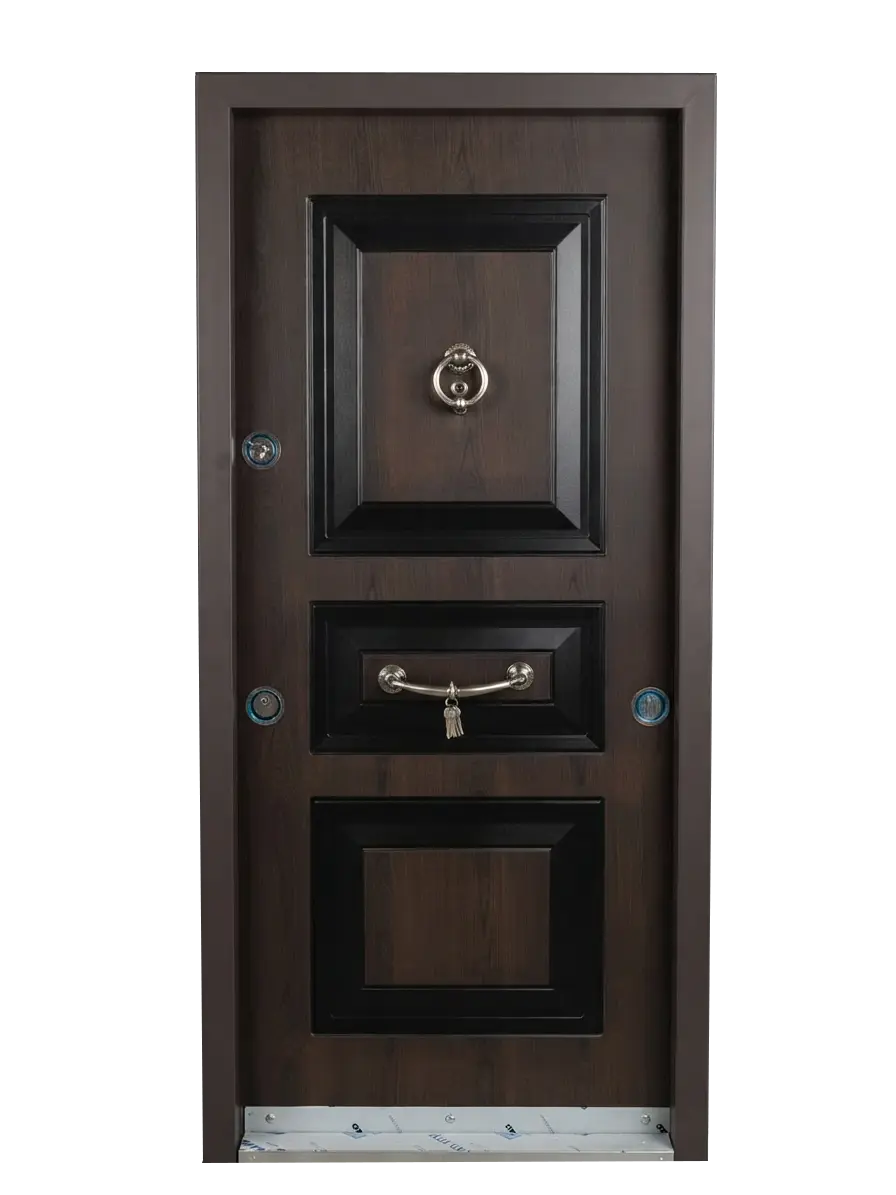
What Is a Door Panel?
A door panel is the visible face component mounted to a steel, timber or aluminium door frame. The base material is almost always MDF (Medium Density Fibreboard) — a wood-derivative board with a density of 600–800 kg/m³ whose smooth, homogeneous surface accepts a wide range of surface treatments.
Door Panel Types
Door panels fall into 5 main categories:
PVC Coated (Membrane) Door Panel
Most PopularProduced by laminating PVC foil onto MDF or particleboard. When applied via vacuum membrane pressing, the foil wraps perfectly around routed profiles and contoured shapes.
- High resistance to moisture and scratches
- Suitable for wet areas — bathroom, kitchen
- Wide range of colours and patterns
- Economical price point
- Easy to clean
- Risk of edge peeling in high-heat environments
- Surface smoothness does not match lacquered quality
Best used for: Hotel rooms, apartment interiors, bathroom and kitchen doors, mass housing projects.
Melamine Coated Door Panel
Produced by hot-pressing a thermofused decorative paper onto MDF. The ready-made surface enables fast production and competitive unit costs.
- Economical price range
- Available in 6 profile variations: flat, eco-grooved, inset, raised, lacquer-primed, raw PVC coated
- Wide pattern and colour selection
- Moderate scratch resistance
- No maintenance required
- Performance drops in humid environments
- Cannot match the smoothness of lacquered panels
- Edge banding visible on cut faces
Best used for: Office doors, school and hospital corridors, dry interior spaces, budget-sensitive projects.
Lacquered Door Panel
Premium SegmentMultiple coats of specialty lacquer paint are applied directly to raw MDF. No edge banding is required, resulting in a seamless, monolithic surface.
- Gloss or matte finish options
- Ideal for modern and minimalist interiors
- Smooth, premium look and feel
- High colour flexibility
- Sensitive to scratches
- Requires regular maintenance
- Higher price segment vs. melamine and PVC
- Risk of yellowing under UV exposure
Best used for: Luxury residential projects, boutique hotels, contemporary office interiors.
Hollow Core (American Panel) Door
Lightweight door constructed with a honeycomb cardboard core framed in timber or MDF and faced with thin HDF or plywood skins.
- Lightweight and easy to handle
- Very economical
- Fast supply in standard sizes
- Very low sound insulation
- Vulnerable to impact damage
- Limited long-term durability
- Not suitable for wet areas
Best used for: Office partition doors, storage and service doors, low-traffic spaces.
Raw MDF Door Panel
Wholesale ChoiceUncoated MDF board with no surface treatment. Supplied to door manufacturers, exporters or surface treatment workshops for downstream processing.
- Lowest unit cost
- Compatible with any surface treatment
- Ideal for bulk industrial production and export
- Cannot be used without a surface coating
- Sensitive to moisture in untreated state
Best used for: Door manufacturers, exporters, surface treatment workshops.
Door Panel Types Comparison Table
| Property | PVC Coated | Melamine | Lacquered | Hollow Core |
|---|---|---|---|---|
| Moisture Resistance | High | Medium | Low | Very Low |
| Scratch Resistance | High | Medium | Low | Medium |
| Sound Insulation | Medium | Medium | Medium | Very Low |
| Price | Economical | Economical | High | Very Economical |
| Suitable for Wet Areas | Yes | No | No | No |
| Aesthetic Level | Medium | Medium | High | Low |
Key Facts About MDF
MDF (Medium Density Fibreboard) is the base material for the vast majority of door panels. With a density of 600–800 kg/m³, its smooth and homogeneous surface makes it ideal for lamination, painting and CNC routing.
HDF (High Density Fibreboard) exceeds 800 kg/m³ in density, making it harder and more impact-resistant. It is commonly used as the face skin on hollow core doors.
Wholesale Door Panel Supply from CİHANPAN
Founded in Kayseri in 1998, CİHANPAN produces 50,000 door panel sets per year and is one of Turkey's leading wholesale MDF door panel exporters. Ready-stock delivery is available for steel door manufacturers, exporters and large-scale construction projects.
- PVC Coated MDF Panel — 10 mm standard thickness, moisture-resistant construction
- Laminoks (Melamine) MDF Panel — scratch-resistant, wide pattern range
- Elitpan UV Lacquered MDF Panel — premium segment, high surface quality
- Laser Cut MDF Panel — CNC custom pattern applications
For a price quote and sample request:
📧 Email: export@cihanpan.com
📱 WhatsApp: +90 544 169 00 38
Conclusion: Which Door Panel Is Right for You?
The right choice among door panel types depends on the application, budget and expected durability.
- Wet areas (bathroom, kitchen) → PVC Coated
- Budget-friendly dry spaces → Melamine
- Modern and luxury interiors → Lacquered
- Low-traffic and service areas → Hollow Core
- Industrial bulk production → Raw MDF Panel
Even the best door panel underperforms if specified for the wrong environment — always match technical properties to the application before aesthetics.
Frequently Asked Questions
What are the types of door panels?
Door panels are classified into five main types: PVC coated (membrane), melamine coated, lacquered, hollow core (American panel) and raw MDF panels.
What is the difference between PVC coated and melamine door panels?
PVC coated panels offer high moisture and scratch resistance and suit wet areas. Melamine panels are economical and suited to dry interior spaces.
Why are lacquered door panels more expensive?
Multiple coats of specialty paint and additional labour time make lacquered panels a higher-cost option than melamine or PVC alternatives.
Why are hollow core doors cheaper?
The honeycomb cardboard core reduces material cost significantly. The trade-off is very low sound insulation and low impact resistance.
Can MDF door panels be used in humid environments?
Standard MDF is not recommended for humid environments. Use PVC coated MDF panels in wet areas such as bathrooms and kitchens.